
 Recruit

Employer of Record in the UK
-
 adminrp
- Published
- 5 11 月, 2026
RemotePeople’s UK Employer of Record hires your UK staff compliantly, with no local entity, 5-10 day onboarding, from $199/employee/month. We handle PAYE, 15% employer NIC, auto-enrolment pension, IR35 classification, right-to-work checks and Skilled Worker visa sponsorship.









The United Kingdom of Great Britain and Northern Ireland once controlled a vast global empire and is still a major economy on the world stage. At over $4.26 trillion, the UK’s GDP ranks 5th in the world in 2026, while the country ranks just 22nd in population with around 69.487 million people. Of this number, the World Bank estimates that over 35.4 million are in the labor force. Roughly 83% of these workers are employed in the service sector, including trade, financial services, business services, and a very important and growing information and technology industry. Clearly, this is a major market to get into. However, employers that want to set up shop in the UK face several challenges. Setting up an entity in the UK can take months and requires many detailed registrations with government bodies. Employing UK citizens through such an entity also requires your company to pay corporation tax locally.
For employers that want to tap into the UK labor market at a smaller scale, working with an Employer of Record is an attractive alternative. By working with an EOR service provider, you can usually get new workers on board and working in just a couple of weeks. The EOR also manages their HR needs on your behalf, including payroll, taxes, and paid time off entitlements, allowing you to leverage expert knowledge without having to burden your own HR team. This guide will explain what UK EOR providers are, the services they provide, and how partnering with one can help you add UK members to your team as quickly as possible.
How an Employer of Record Works in the United Kingdom
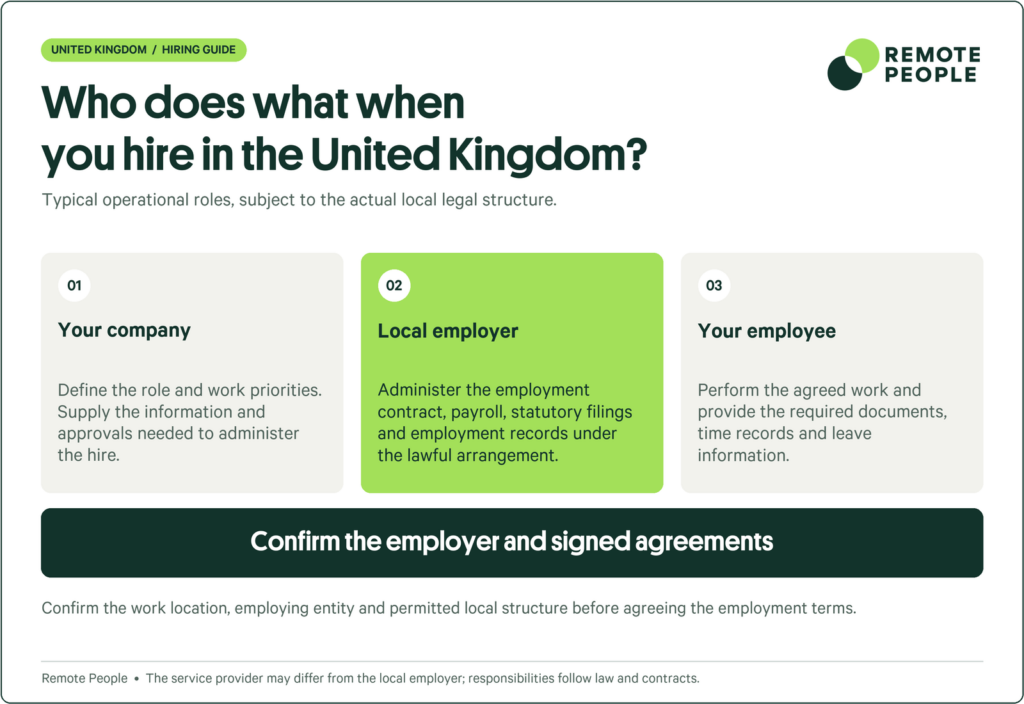
An Employer of Record is a service provider that helps you hire employees in a country where you don’t own an entity. EORs hire your employees directly, become their legal employers, and manage HR services for you.
When to Use an EOR in the United Kingdom
An Employer of Record is a service provider that helps you hire employees in a country where you don’t own an entity. EORs hire your employees directly, become their legal employers, and manage HR services for you.
- Hire quickly: Rather than waiting months to set up a company in the UK, your EOR partner already has an entity it can use to hire workers immediately. This means it can conclude contracts with your new employees, register them with the tax authority (HMRC – HM Revenue and Customs) and the National Insurance Office, check their right to work in the UK, and onboard your workers, all usually within a two-week period.
- Employ a small number of workers without the headache of entity setup: For many employers, setting up an entity in the UK just to be able to hire a small team of not more than 15-20 workers just isn’t worth the time and cost. An EOR lets you access the UK labor market while avoiding this expense, and without having to set up your own HR department specializing in UK regulations as well.
- Test the UK market before registering a local entity: If you’re unsure of your position entering the UK market, rushing in and setting up an entity can be risky. With an EOR, you can hire UK workers to help you test this market while limiting your exposure, letting you access local expertise and skills with less risk.
- Hire non-nationals living in the UK: Employers in the UK can sponsor Skilled Worker Visas for non-nationals to enter and work in the country if they hold Skilled Worker Sponsor Licenses. An EOR that holds such a license can expedite this process, saving you months.
While EORs charge monthly fees to maintain employees, these are often more cost-effective than setting up an entity in the UK and managing HR on your own for teams of up to 15-20 employees.
If you’d like to learn more about how Employer of Record (EOR) services work, read our What Is an Employer of Record (EOR)? guide for a complete overview of the model, its benefits, and when to use it.
If you’re comparing providers, our Best Employer of Record (EOR) Providers guide reviews the leading platforms to help you choose the right solution for your business.
Typical Hiring and Onboarding Timeline
While hiring new employees through an EOR isn’t instantaneous, it can still save you months compared with registering an entity and hiring on your own. Instead of two months, you can usually have employees ready to work in under two weeks.

A typical timeline to hire a new employee includes:
- EOR agreement and employee details (1–2 days): The employer enters into a service agreement with the EOR and shares the personal and employment information of the employee they wish to hire.
- Right-to-work check and contract drafting (2–3 days): The EOR performs a Right-to-Work check to ensure the worker is entitled to work legally in the UK. Once passed, it enters into an employment contract with the employee, based on the salary, benefits, and job description provided by the client.
- HMRC and pension registration (1–2 days): The EOR registers the new employee with HMRC for tax and National Insurance purposes. It also selects an appropriate pension scheme and registers the employee.
- Payroll setup and benefits enrolment (2–3 days):
The EOR adds the employee to the client’s payroll, creating calculations for their salary, mandatory deductions, and contributions to private pensions and other benefits programs. - Employee onboarding and first day (1 day): With onboarding to the EOR already completed, the client will also need to give an orientation to the new employee, provide them with the tools and data they need to start, and introduce them to their supervisors and teammates.
While UK workers can usually get started in about ten days, non-nationals will still take longer to get on board if they require visas to work legally in the UK.
Hire in the United Kingdom
A deep talent pool, English-speaking workforce, and one of Europe’s most familiar legal frameworks make the United Kingdom an attractive market for global teams.
We handle employment contracts, PAYE payroll, tax withholding, and full UK compliance.
No limited company needed. Your team can start in days.
Employment Laws and Regulations in the United Kingdom
While the UK legal system is based on common law, regulations can vary across its four constituents: England, Wales, Scotland, and Northern Ireland. Employment regulations are found in a range of instruments, with the most prominent being the recently enacted Employment Rights Act 2025.
Employment Contracts
UK contracts don’t have to be in writing, but employers are obligated to provide their employees with written statements of the particulars of their employment (a “principal statement”) not later than the date of starting employment. These must be provided as single documents and written in English. They have to include details on working hours, location, leave entitlements, sick pay, holidays, probation period, benefits, and remuneration. Within two months of starting work, the employee must also be given a statement that includes information on their pension scheme, relevant collective agreements, and disciplinary procedures. Most employers simply choose, however, to include these details in carefully constructed written contracts, prepared by their EOR partners.
Contracts in the UK can be permanent or for fixed terms. There are no limits to the duration or number of renewals of fixed-term contracts. After four years of continuous employment, however, employment agreements are automatically converted to permanent contracts. Employers are also prohibited from firing and rehiring workers to contract them with less-favorable terms.
Working Hours and Overtime
UK employees’ working hours are largely controlled by the Working Time Regulations 1998. Unless a worker agrees in writing, an employee can work a maximum of 48 hours in a week, including overtime. However, for shift work, these weekly hours are averaged over a 17-week reference period. Night workers who work at least three regular hours between 11 pm and 6 am cannot work more than eight hours in a 24-hour period.
UK workers are generally contracted to work 35-40 hours per week, either with or without a paid lunch break, and they are entitled to at least one 20-minute rest break after working for six hours. They can only be required to work overtime if this is agreed contractually, if their total hours don’t exceed 48 per week, and if their overtime hours don’t cause them to be paid less than the national minimum wage. Employers are not required to pay premiums for overtime hours unless these are stipulated in employment contracts. They may also agree to give employees time off in lieu (TOIL) of paying them overtime compensation.
While these rules leave a lot of room for negotiation, most employers offer more agreeable conditions in their employment contracts to help them attract top employees. For example, an overtime rate of “time-and-a-quarter” (125% of regular wages) is standard. Many employers also offer 150% of normal wages for work on Saturdays and 200% for work on Sundays and public holidays.
|
Regular Pay and Overtime Rates for UK Workers |
|||
|
Hour Type |
Premium Rate |
Restrictions |
Notes |
|---|---|---|---|
Regular hours |
0% |
Up to 48 hrs/week averaged over 17 weeks (unless opted out) |
|
Weekday overtime (typical contract) |
+25% |
Unlimited, but cannot exceed 48 total working hours/week averaged over 17 weeks (unless opted out) |
Overtime pay is not mandatory in the UK, but many employers offer premium pay. |
Saturday work |
+50% |
Unlimited, but cannot exceed 48 total working hours/week |
Offered optionally by employers for additional work on Saturdays |
Sunday work |
+100% |
Unlimited, but cannot exceed 48 total working hours/week |
Not mandatory, but common. Shop workers have the right to refuse to work on Sundays. |
Bank holiday work |
+100% |
Generally, not more than regular hours performed on a normal working day |
Not mandatory, but many employers offer double-time. |
Professional EOR partners in the UK can recommend compensation levels that are appropriate for and attractive to the talent you’re trying to attract. They write these compensation rules into contracts and payroll calculations, ensuring that your employees are paid correctly in accordance with the terms you set out.
Minimum Wage
The UK carefully restricts employers from paying workers less than its National Minimum Wage and the National Living Wage. All workers, regardless of their positions, experience, or probation status, must be paid at least these strict minimum amounts, though apprentices have different rates than other workers. These minimums are reviewed and updated annually, with new minimums set for the first of April each year. Minimums in the UK are based on age and apprenticeship status as follows:
UK Minimum Wage Levels (1 April 2026 – 31 March 2027) | |
Minimum Wage Level | Who’s Entitled? |
|---|---|
£8.00/hour | Workers from school-leaving age (aged 16 by the end of summer holidays) |
£8.00/hour | Apprentices under the age of 19, or over 19 but in their first year of apprenticeship |
£10.85/hour (National Minimum Wage) | Workers aged 18-20 |
£12.71/hour (National Living Wage) | Workers aged 21 and over |
The employer may pay up to £11.46 per day below the worker’s minimum wage as an offset if providing accommodation. Employers are not required to provide 13th- and 14th-month bonuses in the UK.
While the government-set NLW is £12.71/hour, the Living Wage Foundation calculates higher wages based on the cost of living. It asks employers to voluntarily pay workers £13.45/hour as the “UK real living wage”, and £14.80/hour as the “London real living wage”. You can find out more about minimum wages and appropriate salary levels through our UK minimum wage guide.
Probation Period
Probation periods in the UK are not mandatory, but are instead defined in individual employment contracts. However, they’re widely used by employers across most industries as periods for testing employees’ abilities, competence, and fit within organizations. The UK does not restrict the duration or renewal of probation periods in law. Instead, it mandates rights and protections for workers based on their length of service.
Employees who’ve worked for less than one month can resign or be dismissed without notice. After one month’s service, both parties must provide at least one week’s notice to the other, or more if stipulated in their contracts. Until the end of 2026, workers are not protected from unfair dismissal until they’ve worked for two full years. This means that employers can dismiss workers without providing reasons or just cause. However, on 1 January 2027, this qualifying period will be reduced to six months, including any months worked in 2026.
Most employers in the UK use probation periods of three to six months to assess workers. However, workers enjoy “Day-One Rights” starting from their first day of work, which include paid sick leave, annual leave accrual (1/12th of annual allowance per month), minimum wage, and protection from dismissal due to discrimination and whistleblowing.
Leave Entitlements
Workers in the UK are entitled to leave for various reasons, from annual paid leave to sick leave and family leaves of several types. It’s important to account for these paid leaves when assessing whether or not to hire UK employees.
Annual Leave
Annual paid leave is called a holiday entitlement in the UK. This entitlement is a Day-One Right, meaning that workers begin accruing leave from their first day on the job. Annual leave is calculated at the rate of 5.6 weeks of holiday per year, to a maximum of 28 days.
For full-time employees who work five days a week, this is equal to (5 days/week * 5.6 weeks) 28 working days of paid holiday annually. Workers can take this leave at once or in parts. If public holidays fall within the annual leave period, they may be counted as part of the worker’s holiday, as employers are not obligated to pay workers on public holidays.
In general, workers must use their paid annual leave within the year in which it was earned, unless their contracts allow for leave to be rolled over to the next year. However, employees who are away on sick or family leaves may roll over up to four weeks of annual leave to the next year.
Sick Leave
The Employment Rights Act 2025 removed the waiting period and Lower Earnings Limit for paid sick leave in the UK. Statutory Sick Pay (SSP) is now granted to all workers from the first day they start their jobs. If a worker is sick, they’re entitled to leave with pay, and the weekly SSP rate for employees is £123.25 per week. Employees are entitled to receive this weekly SSP allowance from their employers for up to 28 weeks. During sick leave, employees still accrue annual paid leave as usual.
If a worker is away for a long-term period of sick leave, the employer can consider how to help them return to work (part-time hours, remote or hybrid working, etc.) and work with the employee to understand when they could return to work. After these steps have been taken, the employer may be able to terminate an employee who can’t come back to work.
Maternity Leave
Workers in the UK are entitled to statutory maternity leave of up to 52 weeks. The first 26 weeks, called Ordinary Maternity Leave, can start up to 11 weeks before the due date, and protects a mother’s right to return to her same job. Additional Maternity Leave is also available for another 26 weeks. During this period, the mother’s same job is not fully protected, but the employer must offer a similar position to return to.
Mothers are entitled to Statutory Maternity Pay (SMP) for up to 39 weeks of maternity leave. The first six weeks are paid at 90% of average weekly earnings. The next 33 weeks are paid at this same rate, or £194.32/week, whichever is lower. SMP counts as income and is subject to tax and National Insurance deductions. SMP is paid by the employer, but can usually be reimbursed up to 92% by the government.
Paternity Leave
Partners of new mothers, including biological and adoptive fathers, as well as same-sex partners who will have child-rearing responsibilities, are entitled to paternity leave. They are allowed two regular work-weeks’ worth of leave, which can be taken together or in two separate weeks, and only after delivery. The UK also allows up to six hours of leave for antenatal appointments. Paternity leave is paid by employers at the rate of £194.32/week or 90% of average weekly earnings, whichever is lower. Again, employers are normally reimbursed for paternity leave pay by the UK Government. To qualify for paternity leave pay, employees must have been continuously employed for at least 26 weeks in advance of the 15th week before a baby is due. However, taking the leave itself is now a Day-One Right with no qualifying period.
Other Statutory Leaves
Aside from these major leave categories, UK employees may be eligible for other leaves. Most are paid for initially by the employer, though employers can usually reclaim up to 92% of these payments from HMRC. Employers who pay £45,000 or less in Class 1 National Insurance can actually reclaim 109% as a form of relief for small employers.
- Shared Parental Leave: New parents can take up to 50 weeks of shared parental leave (SPL) between them instead of only maternity leave or adoption leave. This leave is paid for the first 37 weeks at £194.32/week.
Neonatal Care Leave: Parents can claim neonatal care leave of up to 12 weeks when their newborns are premature, sick, or requiring special care staring in the 28 days after birth. Employers pay the lower of £187.18/week or 90% of average weekly earnings. - Adoption Leave: Parents who adopt or have children through surrogacy can take up to 52 weeks of leave. As with maternity leave, adoption leave is split into 26 weeks of ordinary leave and 26 more of additional, less-job-protected leave. This leave can start 14 days before the adoptive child is scheduled to begin living with the parents.
- Bereavement Leave: Parents who lose children under age 18 or fetuses after 24 weeks (or miscarriages before 24 weeks in Northern Ireland) are entitled to two weeks’ bereavement leave. This leave is paid at £194.32 a week or 90% of your average weekly earnings, whichever is lower. Partners can also take bereaved partner’s paternity leave (BPPL) if the mother dies during the first year of a child’s life. A week of bereavement leave for close relatives is expected to be introduced in 2027.
- Carer’s Leave: Employees can take one week of carer’s leave per rolling 12 months to care for dependants who need long-term care, including those who are disabled, aged, or have suffered accidents.
- Time Off for Dependants: The Employment Rights Act 2025 requires employers to allow employees to take a reasonable amount of time off work, unpaid, to deal with emergencies affecting dependants like a spouse, child, grandchild, or parent. This leave may also be called “compassionate leave”.
|
Table of UK Employment Leave Entitlements |
||
|
Leave Type |
Duration |
Pay Rate (2026/27) |
|---|---|---|
Annual leave |
5.6 weeks per year (28 days for a 5-day workweek) |
100% of normal pay |
Sick Leave |
Up to 28 weeks |
£123.25/week or 80% of average weekly earnings, whichever is lower |
Maternity Leave |
52 weeks (26 ordinary + 26 additional) |
6 weeks at 90% of average earnings, 33 weeks at £194.32/week or 90%, whichever is lower (13 weeks unpaid) |
Paternity Leave |
2 weeks (taken in one or two blocks) |
£194.32/week or 90% of average earnings, whichever is lower |
Shared Parental Leave |
Up to 50 weeks |
37 weeks paid at £194.32/week or 90%, whichever is lower (13 weeks unpaid) |
Neonatal Care Leave |
Up to 12 weeks |
£187.18/week or 90% of average earnings, whichever is lower |
Adoption Leave |
52 weeks (26 ordinary + 26 additional) |
Same as for Maternity Leave |
Parental Bereavement Leave |
2 weeks |
Paid at employer discretion; statutory rate £194.32/week where applicable |
Bereaved Partner’s Paternity Leave |
Up to 52 weeks |
Same as for Maternity Leave |
Carer’s Leave |
1 week per rolling 12 months |
Unpaid |
Time Off for Dependents |
A “reasonable” amount of time to deal with emergencies |
Unpaid |
When you hire UK employees through an EOR, it takes on the responsibility for leave management, also known as paid time off (PTO). Using automated systems with built-in entitlement rules, your EOR partner can ensure that your employees receive their legal entitlements to time off and pay, leaving you to simply manage scheduling.
Work Permits and Visas in the United Kingdom
If you want to hire employees who are not UK nationals but who will relocate to work in the UK, an EOR can help you sponsor their visa applications. Most of these workers will use Skilled Worker Visas to enter and work legally in the UK, and they do not need separate “work permits”. Only employers who are approved by the Home Office can issue Certificates of Sponsorship along with the contracts they offer to foreign skilled workers. It can take months to obtain a sponsor license from the Home Office, while working with an EOR that already holds a license can save you this crucial time.
You can only hire and sponsor Skilled Worker visas for non-nationals if you contract them for a minimum amount. For most workers, this means the higher of 100% of the going rate for their job type, or £41,700 per year, while health and care workers must be paid at least £31,100 per year. Other employees may have higher minimums. You must also pay an immigration skills charge of £1,000/year to hire non-nationals and a certificate of sponsorship fee of £525. The employee must pay visa fees (up to £1,751), as well as an immigration health surcharge of £1,035/year. These visas can be issued for up to five years and can be renewed.
The Skilled Worker Visa and other visa types that you may use to sponsor non-nationals to work in the UK are summarized in this table:
UK Work Visa Options | ||
Visa Option | Who Qualifies | Maximum Validity |
|---|---|---|
Skilled Worker Visa | Worker with job offers from a licensed sponsor paying at least £41,700/year (or the going rate for that job, whichever is higher) | 5 years, extendable |
Global Business Mobility – Senior or Specialist Worker | Senior managers or specialist employees transferring from an overseas branch of the same corporate group; paid at least £52,500/year | 5 years (9 years if paid £73,900/year or more) |
Global Business Mobility – Graduate Trainee | Graduate trainees on a structured program working at a UK branch of an overseas corporation; paid at least £27,300/year | 12 months |
Scale-Up Visa | Workers joining a fast-growing UK business with an authorized sponsor, on a salary of at least £39,100 per year (or the going rate for that job, whichever is higher) | 2 years initially; can be extended or changed to Skilled Worker or Global Talent Visa |
Global Talent Visa | Leaders in academia, research, arts, culture, or digital technology, endorsed by an approved body or having won a prestigious prize; over 18 | 5 years, extendable |
High Potential Individual Visa | Recent graduates (past 5 years) from an eligible top-50 global university; no sponsor required | 2 years (3 with PhD); non-extendable; can be changed to Skilled Worker Visa |
Graduate Visa | Students who successfully completed an eligible UK degree; no sponsor required | 2 years for applications before the end of 2026; 18 months for 2027 applications; can be changed to Skilled Worker Visa |
Payroll and Taxes in the United Kingdom
When you partner with a UK EOR, it manages payroll for your employees in the country. In addition to calculating and paying employee salaries from your funded payroll, the EOR also handles all mandatory employer contributions and employee deductions, ensuring compliance at all times.
Employer Contributions
The UK requires employers to make contributions to multiple social programs, including National Insurance, pension schemes, the Apprenticeship Levy, and liability insurance.
Employers must make National Insurance contributions once their employees exceed the Second Threshold of earnings, which is £96/week, £417/month, or £5,000/year. From this point onward, employers contribute an additional $15 of each employee’s salary. There is no upper limit for workers’ earnings. Employers only start making contributions for employees under the age of 21, however, when their monthly earnings exceed £4,189/month.
Large employers pay an Apprenticeship Levy which goes toward training programs. This is assessed as 0.5% of earnings above a total company payroll of £3 million. Employers contribute to pension schemes at the rate of 3.0% of employee earnings, but only when employees make more than £120/week or £520/month. Finally, employers are required to hold liability insurance with at least £5 million in coverage. Private insurers can charge between 0.1% and 1.5% of payroll, depending on the size and risk level of a business.
| Contribution Type | Rate (% of Salary) | Notes |
|---|---|---|
| Class 1 National Insurance | 15.00% | On earnings above the £5,000/year Secondary Threshold; no upper limit |
| Apprenticeship Levy | 0.50% | On annual payroll above a £3 million allowance |
| Pension Contributions (minimum) | 3.00% | On employee earnings between £6,240 and £50,270; often salary-sacrificed |
| Employer’s Liability Insurance | ~0.1%–1.50% | Compulsory under the Employers’ Liability (Compulsory Insurance) Act 1969; minimum £5 million coverage |
| Total Employer Burden | ~18–20% | Above gross salary |
For more detailed information on employer contributions and payroll calculations, visit our United Kingdom payroll and income tax guide.
Employee Deductions
As in most countries, employers in the UK are responsible for calculating and withholding various deductions from their employees’ pay, including pay-as-you-earn (PAYE) income tax, National Insurance, and pensions.
UK workers pay 20-45% tax on earnings over £12,570, and their employers must withhold these payments and remit them to HMRC. Like their employers, they also contribute to the National Insurance scheme, paying 8% of their earnings from £1,048/month to £4,189/month. Above £4,189/month, however, they pay a reduced rate of just 2% of their earnings. Workers must contribute at least 5% of their earnings from £6,240–£50,270/year to their pension schemes.
If employees must pay back student loans, these payments are also automatically deducted by their employers. They have to pay 9% of their earnings above £28,470/year until their loans are repaid.
| Deduction Type | Rate (% of Salary) | Notes |
|---|---|---|
| Income Tax | 20%-45% | Taxable income over £12,570 |
| Class 1 Primary National Insurance (main rate) | 8% | On earnings between |
| Class 1 Primary National Insurance (upper rate) | 2% | On earnings above £4,189 per month (no upper limit) |
| Workplace Pension (minimum) | 5% | On qualifying earnings £6,240–£50,270 |
| Student loan (Plan 2, most common) | 9% | On earnings above £28,470 per year (Plan 2 threshold for 2026/27) |
Income Tax Brackets
Employees in the UK must pay income tax on all earnings over the tax-free personal allowance – their first £12,570. However, once earnings reach £100,000/year, the personal allowance decreases by £1 for every £2 of income. Above this allowance, most workers pay 20% in PAYE taxes, deducted regularly by their employers. High earners may reach the higher and additional rate bands and pay 40-45% tax. The following tables provide rates for the current UK tax year, which runs from 6 April 2026 to 5 April 2027.
Income Tax Brackets – England, Wales, and Northern Ireland | |
Taxable Income per Year | Tax Rate |
|---|---|
£0 – £12,570 (Personal Allowance) | 0% |
£12,571 – £50,270 (Basic rate band) | 20% |
£50,271 – £125,140 (Higher rate band) | 40% |
Above £125,140 (Additional rate) | 45% |
Scotland uses the same personal allowance as the rest of the UK. However, it divides income tax into six bands instead of three, as shown in the table below:
Income Tax Brackets – Scotland | |
Taxable Income per Year | Tax Rate |
|---|---|
£0 – £12,570 (Personal Allowance) | 0% |
£12,571 – £16,537 (Starter rate band) | 19% |
£16,538 – £29,526 (Basic rate band) | 20% |
£29,526 – £43,662 (Intermediate rate band) | 21% |
£43,663 – £75,000 (Higher rate band) | 42% |
£75,001 – £125,140 (Advanced rate band) | 45% |
Above £125,140 (Top rate) | 48% |
Cost of Hiring an Employee Through an EOR in the United Kingdom
The total cost of hiring an employee in the UK through an EOR depends on several factors. Their seniority and expertise will dictate their salary level, which will in turn affect the levels of employer contributions for National Insurance and pensions. The EOR you choose to partner with will add its monthly rate, and if it owns a large entity, you’ll also need to cover the Apprenticeship Levy. Contributions.
The following is a sample calculation showing the monthly and annual costs that you could incur when hiring a UK employee. We’ve selected a gross annual salary of £48,000, which is commensurate with a mid-career marketing or business management professional, as well as a moderately low EOR service fee.
|
UK Employee Total Cost Calculation Example |
||
|
Employer Cost |
Monthly (USD) |
Annually (USD) |
|---|---|---|
Gross salary (~£48,000/year) |
$5,200 |
$62,400 |
Employer National Insurance (15% above £5,000) |
$699 |
$8,384 |
Auto-enrolment pension (employer 3%) |
$104 |
$1,252 |
Apprenticeship Levy (large-employer estimate) |
$26 |
$312 |
Employers’ liability insurance + payroll admin |
$50 |
$600 |
EOR service fee (flat) |
$399 |
$4,788 |
Total cost |
$6,478 |
$77,736 |
Exchange rate: approximately £1 = $1.30 (September 2026). Actual cost can vary by exchange rate, benefits package, and EOR partner fees.
In this example, the total cost of employment for this worker is close to 25% over their gross salary, with only 6% of this cost coming from the EOR’s fees. The TCE percentage for higher-earning employees will be higher because National Insurance contributions don’t have an upper threshold, and lower for lower-earning employees.
Terminating an Employee in the United Kingdom
The UK has a long history of protecting the rights of both workers and employers. Legal statutes control notice periods, severance pay, grounds for termination, and dispute procedures.
Grounds for Termination
As outlined in the Employment Rights Act 2025, employees can be legally terminated for these reasons:
- inability to perform your job properly (ex. unable to adapt to technological changes in the industry)
- long-term illness (ex. inability to return to work, even with reduced or flexible hours)
- gross misconduct (ex. violence towards a coworker or customer)
- inability to employ the employee in the future (ex. the employing company closes down)
- statutory restrictions (ex. the employee doesn’t hold required permits to perform their work)
- “substantial” reasons (ex. the employee is imprisoned)
Currently, employers can terminate workers for any reason if they haven’t been employed for at least two years, while after this period, they need to have reasonable justifications like those above and follow fair dismissal procedures. However, beginning in 2027, the period in which employees are not protected against unfair dismissal will be shortened to six months.
From Day One of their employment, however, all workers are protected against dismissal due to discrimination, whistleblowing, trade union membership, or asserting statutory rights.
Notice Periods
Unlike in most American states, the UK is not an at-will jurisdiction. Employers not only need to justify dismissals, but they must also provide notice to their workers of impending terminations. Likewise, employees have to give notice to their employers should they choose to resign from their jobs, but they only need to give one week’s notice if they’ve worked for one month or longer. Neither the employee nor the employer needs to give notice if the employee has worked for less than one month.
Minimum mandatory notice periods are dictated by the Employment Rights Act 2025. However, employers and employees may agree to longer periods in their contracts. Many employers choose to offer one to three months’ notice as an added condition to help them attract top talent. Employers are not required to offer payment in lieu of notice (PILON), but they can choose to add this possibility in their contracts, which helps them to remove unwanted employees as quickly as possible while still meeting their legal obligations.
| Length of Continuous Service | Minimum Notice for Employers |
|---|---|
| Less than 1 month | None |
| 1 month to less than 2 years | 1 week |
| 2 years to less than 11 years | 1 week for each year of service |
| 12 years or more | 12 weeks (statutory maximum) |
Severance Pay
While severance pay is not mandated for all UK employees across the board, employers may still have responsibilities to employees dismissed for economic reasons, or if their contracts promise severance.
Statutory Severance Pay
The Employment Rights Act 2025 only requires employers to provide mandatory severance pay to employees terminated for economic reasons or redundancy. Workers are only eligible if they worked for at least two years for their employers before being terminated, and they must apply for their redundancy pay within six months of their termination.
The amount of redundancy pay given to workers depends on three factors: the worker’s age, the length of their service, and the weekly and total pay caps enforced in that tax year. For the 2026/27 tax year, the weekly pay cap is £751/week, and the maximum redundancy pay employees can collect is £22,530.
- Workers below the age of 22 are paid half a week’s pay for each full year of service.
- Workers aged 22-40 are paid one week’s pay for each full year of service.
- Workers over 41 are paid one-and-a-half weeks’ pay for each full year of service (to the pay cap).
However, if employers offer to keep employees on their payroll, or offer them suitable alternative employment which they refuse, those workers are not entitled to redundancy pay.
Contractual Severance and Settlement Agreements
Employers may choose to add severance payment clauses to their contracts, or employees may demand them. If included, they are, of course, legally binding as long as they represent amounts equal to or greater than the redundancy payments required by law for employees dismissed for economic reasons. Employers may also offer severance packages in exchange for employees voluntarily resigning.
Legally binding settlement agreements may also be used as an alternative when the employer needs to downsize. Through these agreements, the employer agrees to pay severance of an agreed amount, while the employee agrees to leave the job amicably and waive their right to sue for unfair dismissal. The first £30,000 of these settlement payments is non-taxable income, while anything in excess is treated as standard employment income for the employee.
United Kingdom Redundancy Pay | |
Age at Termination | Redundancy Pay Owed Per Full Year of Service |
|---|---|
Under 22 | 0.5 week’s pay (capped at £375.50) |
22 to 40 | 1 week’s pay (capped at £751) |
41 and over | 1.5 weeks’ pay (capped at £1,126.50) |
Maximum total payment 2026/27 | £22,530 |
Public Holidays in the United Kingdom
Public holidays in the UK are referred to as “bank holidays” and are set by the Banking and Financial Dealings Act 1971, as well as by Royal Proclamations by the King. There are normally eight bank holidays in England and Wales, nine in Scotland, and ten in Northern Ireland each year. However, employers are not legally required to give employees time off on these holidays, nor to pay workers a premium rate for working on them.
In practice, however, most employers either offer paid time off on these days, or give compensatory days off to employees required to work on bank holidays. Many other employers pay their employees 200% of their normal wages for working on these holidays. Regardless, these terms are included in employee contracts and are generally expected by high-quality workers.
No matter which part of the UK your employees live in or how you choose to compensate them for public holidays, your EOR partner will manage these public holidays, keeping pay and schedules in strict accordance with their contracts.
| Holiday Name | Date 2026/2027 | Notes |
|---|---|---|
| St Andrew’s Day | Monday, 30 November 2026 | Scotland only |
| Christmas Day | Friday, 25 December 2026 | Statutory bank holiday |
| Boxing Day | Monday, 28 December 2026 | Substitute for Saturday 26 December |
| New Year’s Day | Friday, 1 January 2027 | National bank holiday |
| 2nd January | Monday, 4 January 2027 | Scotland only, substitute for 2 January |
| Good Friday | Friday, 26 March 2027 | Common-law bank holiday |
| Easter Monday | Monday, 29 March 2026 | Statutory bank holiday (not Scotland) |
| Early May Bank Holiday | Monday, 3 May 2027 | First Monday of May |
| Spring Bank Holiday | Monday, 31 May 2027 | Last Monday of May |
| Battle of the Boyne (Orangemen’s Day) | 12 July 2027 | Northern Ireland only |
| Summer Bank Holiday | Monday, 2 August 2027 | First Monday of August (Scotland only) |
| Summer Bank Holiday | Monday, 30 August 2027 | Last Monday of August (not Scotland) |
| St Andrew’s Day | Tuesday, 30 November 2027 | Scotland only |
| Christmas Day | Monday, 27 December 2027 | Substitute for 25 December |
| Boxing Day | Tuesday, 28 December 2027 | Substitute for 26 December |
Benefits of Using an Employer of Record in the United Kingdom
By using an EOR, you can tap into the UK labor market without needing to register an entity in the country, manage HR on your own, or learn how to stay compliant with the multitude of local laws. Instead, your EOR partner handles all of this for you and more, providing you with benefits like:
- Avoiding the cost of setting up a local entity: It can take months to register an entity in the UK with the Companies House, HMRC, and The Pensions Regulator, and then you have to run it, managing payroll, taxes, and HR for your local employees. An EOR partner already has a registered entity that can hire your employees, and it manages payroll and HR for you.
- Fast market entry: Instead of waiting eight weeks or more to register an entity, you can get started hiring UK employees today. It typically takes an EOR between one and two weeks to check, register, and onboard your new employees.
- Built-in compliance with UK employment law: While it’s important to understand UK employment regulations like the Employment Rights Act 2025, Equality Act, and Working Time Regulations 1998, you don’t need to be an expert. Instead, your EOR partner will create compliant contracts and ensure your employees receive all of their entitlements.
- Reduced employment liability: As the legal employer of your worker in the UK, your EOR shields you from risk by taking on responsibility for compliance, fair terminations, and disputes.
- Sponsor license access on day one: If you engage an EOR that is already licensed by the Home Office, you’ll be immediately able to offer Certificates of Sponsorship to non-UK nationals to help them acquire visas to live and work in the UK.
- Supplementary benefits at great rates: Because EORs hire for multiple clients at once, they can use their scale to negotiate competitive rates on supplementary benefits that you may wish to offer your employees, like private medical insurance, life insurance, and additional pension schemes.
- Scalable hiring: You can quickly add more employees to your payroll without having to scale up a local business, and reduce your employee load just as easily when needed.
EOR vs Other Hiring Models in the United Kingdom
Working with an Employer of Record isn’t the only way to get your hands on talented UK workers. You could set up your own entity instead or stick to collaborating with independent contractors. In this section, we’ll examine the pros and cons of these options to give you a clear idea of whether or not partnering with an EOR in the UK is the best choice for your specific needs.
EOR vs Setting Up a UK Limited Company
To set up an entity in the UK, you need to register a unique company name with Companies House, obtain a PAYE number from HMRC, open a UK bank account, and more. This normally takes at least six to eight months. You’d then need to learn to manage HR on your own, or hire an HR professional to help you manage your employees long term. Working with an EOR allows you to skip all of these steps, because the EOR will already own a registered entity in the UK that can hire employees legally. It’s usually more cost-effective to hire with an EOR until you exceed 15 to 20 employees in the UK.
United Kingdom EOR vs. Local Entity Comparison | ||
Employer of Record | UK Limited Company (Ltd) | |
|---|---|---|
7–10 business days | Time to first hire | 6–8 weeks (incorporation, PAYE, bank account) |
Per-employee fee (can range from 200-1000/employee per month) | Costs | 2,000–5,000 legal + incorporation costs, and ongoing HR costs |
EOR handles PAYE, NIC, pension, HR | Ongoing compliance | Self-managed: Companies House accounts, CT600, VAT, PAYE |
1–15 UK employees | Best for team size | 15+ UK employees or long-term base |
Typically cheaper below 15–20 hires | Break-even point | Typically cheaper above 15–20 hires |
Included on day one through the EOR’s license | Sponsor license for visas | 8–12 weeks to obtain Home Office license |
EOR manages, with indemnity in contract | Employer liability for claims | Self-managed, full tribunal exposure |
EOR vs Hiring Contractors
You can also choose to work with self-employed contractors in the UK, though this carries an inherent risk. The people you hire must work for you outside the IR35 off-payroll working rules, which determine how much control you have over how they work. If your workers are found to be misclassified as contractors when they should have been treated as employees, you may be liable for back taxes and serious penalties. Still, contractors can be highly beneficial when you need specific expertise for short-term projects.
UK EOR vs. Hiring Contractors Comparison | ||
Employer of Record | UK Contractor | |
|---|---|---|
Employee under the Employment Rights Act 1996 | Legal employment status | Self-employed under contract for services |
None: PAYE employee from day one | IR35 / off-payroll risk | HMRC may reclassify under IR35 with back-tax, interest, penalties |
Full entitlement (5.6 weeks holiday, SSP, SMP) | Statutory leave and benefits | None |
Auto-enrolled and partially employer-funded | Pension | Self-funded |
Employer withholds PAYE + National Insurance | Payroll taxes | Contractor invoices + self-assesses |
Permanent, full-time roles | Typical use cases | Short-term projects, genuine business-to-business |
Managed by EOR | Client tax liability | Medium or large clients must assess IR35 status under Chapter 10, ITEPA 2003 |
How to Get Started with an EOR in the United Kingdom
It’s surprisingly fast and easy to start working with an EOR to employ UK workers for your team. This three-step process can help you hire and onboard new employees, usually in just one to two weeks:
- Obtain a quote: After shopping around for a reputable EOR, you can share the number, position, salary, and benefit information of the employees you want to hire. The EOR will provide you with a quote for its services and should also give you the total cost of employment for these workers.
- Engage the EOR and hire: If you accept the quote, you can sign a service agreement with the EOR to get started. You’ll share the employees’ names, and the EOR will register them with the authorities and onboard them to its system. You’ll also need to onboard the workers to your company so they can start working for you.
- Fund your monthly payroll and manage day-to-day activities: You’ll handle your employees’ regular schedules and work tasks, and fund your payroll every month. The EOR will take care of HR services, paying your employees, and ensuring constant compliance with UK laws.
Choosing the right EOR partner is more than a matter of picking the lowest price. While you need your partner’s services to be cost-effective, you also need it to be reliable, have an excellent reputation for compliance, and own its own entity in the UK. Remote People owns a local entity in the UK, holds a sponsorship license for Skilled Worker Visas, and offers some of the most affordable fees in the industry. Our advanced platform and skilled experts manage your UK employees’ needs compliantly and effectively, letting you focus on building value for your business.
Frequently Asked Questions
Different EORs charge a wide range of rates depending on the services they offer, their platform technology, and the customization they provide. Their fees can range from 200-1000/employee per month. Additional fees for recruitment, supplementary benefits management, and other services may also be assessed. It’s important to add these expenses to salaries and benefits to figure out the total cost of employment (TEC), and to compare this to the cost of setting up and running a UK entity when making hiring decisions.
No, this is one of the main advantages of hiring through an EOR. Instead of setting up an entity and hiring employees directly, your EOR partner uses an entity it owns in the UK to contract your employees and become their legal employer in the country. This company will register with Companies House, pay taxes to HMRC, and manage contributions to The Pension Regulator on your behalf. It will also manage contracts, handle paid leave, and ensure that all of your legal obligations to your UK employees are correctly fulfilled.
It normally takes no more than two to three weeks to engage an EOR and work with it to hire employees in the UK. Many high-quality EORs are able to shorten this time to between seven and ten business days. Once you provide the EOR with information on the people you want to hire, it quickly checks their right to work in the UK, enters into contracts with them, registers them with the appropriate government agencies, and onboards them to its systems.
The total cost of employment (TCE) for an employee in the UK can vary substantially, depending on their salary and the fees charged by your EOR. With contributions to National Insurance and pensions, the cost of hiring a UK employee starts at 18% above gross salary. With EOR fees included, the TCE can range from 20-30% above gross salary, especially as National Insurance contributions don’t have an upper limit.
Most EORs offer contractor management services and help you pay contractors in the UK. Some, like Remote People, can also act as Contractors of Record, reducing your risk by hiring your contractors directly.
Employers need to pay 15% of each employee’s earnings over £5,000/year to the National Insurance scheme. There is no upper limit to these contributions, so the higher a worker’s salary, the more the employer will need to contribute.
If you want to hire non-UK nationals to work for you in the UK, they need to hold visas that give them the right to work. For most skilled employees, this means Skilled Worker Visas, which must be sponsored by a UK entity that holds a sponsor license from the Home Office. If your EOR’s entity holds this license, it can issue certificates of sponsorship to help your employees obtain visas.
When you hire through an EOR, it becomes the legal employer of your workers. If you need to terminate someone, you can confer with the EOR’s legal experts to ensure that the termination is justified. The EOR will then terminate its contract with the worker, giving them the notice they’re entitled to. If you’ve terminated them for economic reasons, or if you’ve promised severance pay in their contract, the EOR will handle redundancy or severance payments. It will also report their termination to The Pensions Regulator and HMRC.
There is no mandate requiring UK employers to pay 13th-month salaries or other similar bonuses. However, some employers choose to offer this added benefit to attract top talent to their teams.
The UK updates its minimum wage every April 1st. From 1 April 2026 to 31 March 2027, the National Minimum Wage for workers aged 18-20 is £10.85/hour. Employees aged 21 and over must be paid at least the National Living Wage of £12.71/hour. Workers aged 16-18 and apprentices under 19 or in their first year of apprenticeship can be paid £8.00/hour.
Employer of Record in
Employer of Record in
Employer of Record in
Employer of Record in
Employer of Record in
Employer of Record in
Employer of Record in
Employer of Record in